
Machining Kapton for Aerospace: Precision That Survives the Environment
Kapton polyimide is one of the most specified materials in aerospace — and one of the most demanding to machine correctly. Why the material behaves the way it does, and what that…
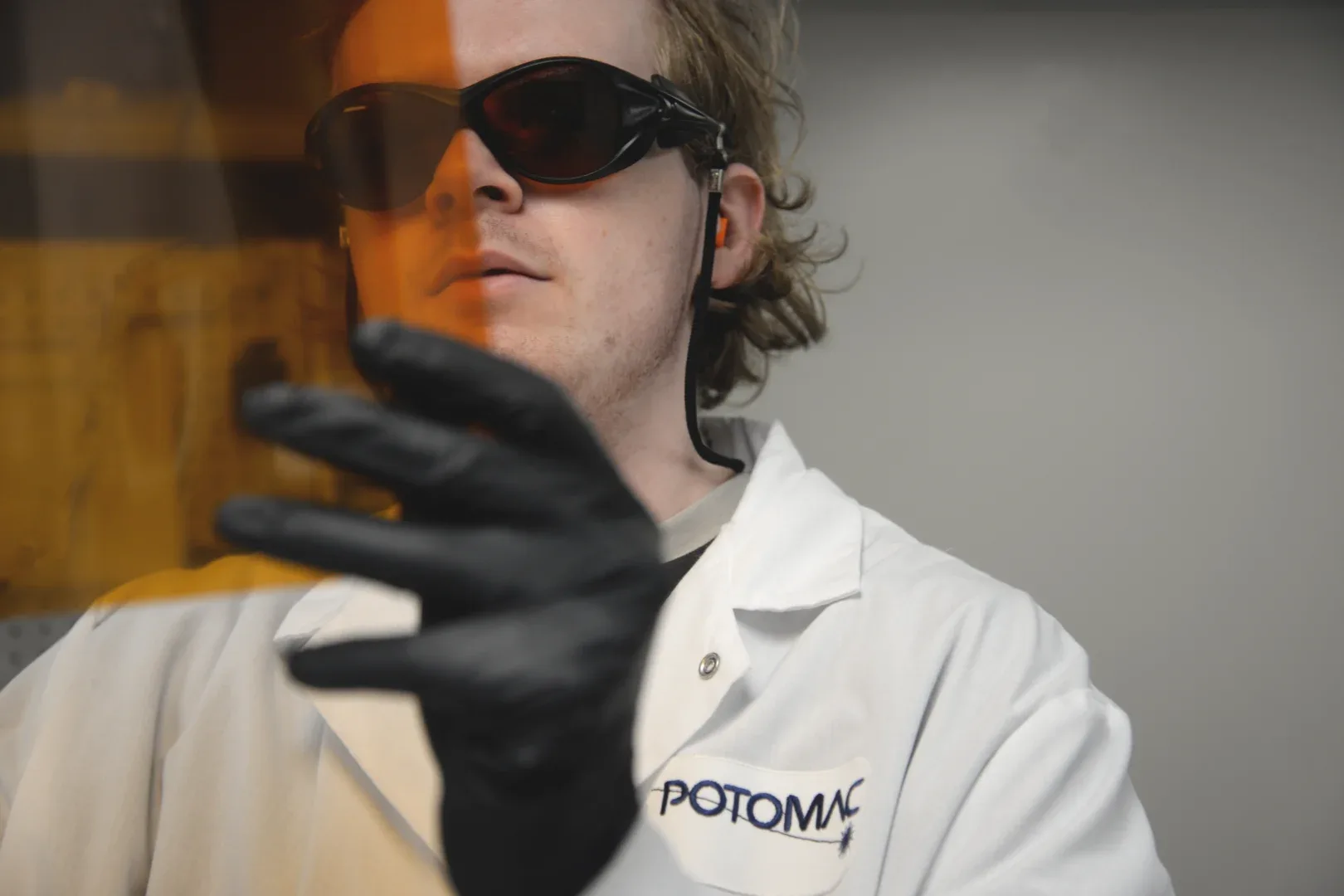
Look inside any satellite thermal blanket, avionics flex harness, or spacecraft flexible heater and you will find Kapton polyimide film. It is one of the most specified materials in the aerospace and space industries — and one of the most demanding to machine correctly.
At Potomac Photonics, precision laser machining of Kapton is a core capability, and understanding why the material behaves the way it does under different machining processes is central to producing components that perform through qualification and beyond.
Why Kapton is everywhere in aerospace
Kapton’s dominance in aerospace starts with its molecular structure. Its five-membered imide ring — formed through the polymerisation of pyromellitic dianhydride and 4,4′-oxydianiline — reaches thermal degradation before entering a glass transition, giving the film a continuous service ceiling of 400°C and cryogenic performance down to −269°C without the progressive softening that limits other engineering polymers. That 669-degree service window covers everything from cryogenic propellant line insulation to engine bay wiring, in a single material.
The electrical properties are equally uncompromising: dielectric strength of approximately 7,700 V/mil, volume resistivity of 1017 Ω·cm, and a dissipation factor of 0.002 at 1 kHz. In vacuum, Kapton HN — the most widely used aerospace grade — returns total mass loss (TML) values typically below 1.0% and collected volatile condensable material (CVCM) below 0.1% per ASTM E595, meeting the outgassing thresholds that spacecraft programmes require to protect optical surfaces and thermal control coatings on orbit.
Kapton is available in several grades, each optimised for a specific class of application:
| Grade | What it does | Where it’s used |
|---|---|---|
| HN | General purpose — balanced thermal, electrical, mechanical properties | MLI blankets, harness insulation, general flex substrates |
| FN | FEP fluorocarbon coating on one face for heat-sealing | MLI outer plies, thermal blanket assembly |
| MT | Alumina-filled for improved through-plane thermal conductivity | Thermal interface layers, conductive flex heaters |
| CR | Corona-resistant for sustained high-voltage environments | High-voltage harness insulation, power distribution |
| FCR | Adhesive-compatible surface for flex circuit lamination | Rigid-flex and flex PCB dielectric layers per IPC-2223C |
The machining challenge most programmes underestimate
Specifying the right Kapton grade is the first decision. The second — and the one where component performance is most often determined — is how the film is machined. Kapton is used in applications that require features well below 0.5 mm: via holes drilled through flex circuit dielectrics for copper plating, precisely defined resistive trace geometries in thin-film heaters, apertures and cutouts in metallised MLI layers where the vacuum-deposited aluminium must remain intact to within 50 µm of the cut edge. At this scale, the machining process leaves a signature on the part that persists into service.
A ±10 µm variation in trace width across a Kapton flexible heater designed for 15 Ω/sq produces resistance non-uniformity that translates directly into hotspot formation at operating current.
Die-cutting and mechanical punching are cost-effective at scale for simple geometries with minimum features above approximately 0.5 mm. Below that threshold — or wherever internal apertures, complex profiles, and tight dimensional tolerances combine in the same part — tool wear introduces dimensional drift that requires frequent inspection and replacement, and the compressive stress of the cutting action can introduce local deformation in the Kapton that affects bondline flatness.
CO₂ laser cutting at 10.6 µm removes material through a photothermal mechanism: energy thermalises into the polymer, raising local temperature above the approximately 500°C decomposition onset for Kapton HN. The resulting heat-affected zone — a gradient of thermally degraded polymer extending several micrometres from the visible feature edge — reduces adhesion at the feature wall, compromises the integrity of plated via connections, and creates initiation sites for fatigue under the thermal cycling profiles of a flight qualification test per DO-160G.
UV laser machining: the physics of a clean edge
At 248 nm, the wavelength of a krypton fluoride excimer laser, Kapton’s absorption coefficient exceeds 105 cm−1. Photons are absorbed within the outermost hundreds of nanometres of the material and carry sufficient energy to break imide ring C–N bonds directly — bond dissociation energy approximately 305 kJ/mol — through a photochemical rather than photothermal mechanism. Material is ejected as gas-phase fragments. The heat-affected zone at the feature wall is measured in tens to hundreds of nanometres rather than micrometres. The edge is chemically intact polyimide, with surface chemistry and adhesion characteristics consistent with the as-received film.
For via drilling in flex circuit substrates, this matters because a chemically clean polyimide wall presents a defined, consistent surface to the electroless copper seeding bath. Via aspect ratios up to 1:1 (diameter equal to dielectric thickness) are achievable without wall taper degradation. For metallised MLI films, UV laser processing preserves the vacuum-deposited aluminium layer to within the feature edge, with no thermal uplift or redeposition contaminating the surrounding metallisation. For Kapton flex heaters bonded to flight hardware, the laser-processed edge holds adhesive consistently through thermal cycling in a way that mechanically processed or infrared-laser-processed edges do not.
How we work at Potomac Photonics
Our UV laser systems are configured with process parameters set specifically for the Kapton grade and thickness being machined — not transferred from a generic polyimide recipe. Ablation behaviour differs meaningfully between HN and CR grades and between 12.5 µm and 125 µm film thicknesses. Pulse energy, repetition rate, focus depth, pass strategy, and assist gas conditions are calibrated to the material at hand. Positional accuracy across the work area is held to ±1 µm. Feature widths below 50 µm are achievable in standard grades.
Every process parameter is captured in the machine file that produced the part. That file is the process record — reproducible on demand, version-controlled, and directly supports the traceability and documentation requirements of aerospace and space programmes operating under standards and specifications such as AS9102, IPC-6013, DO-160, ASTM E595, and ECSS frameworks.
The same file that runs a 50-part development set runs a 5,000-part production programme with identical dimensional output, which matters when the prototype geometry constitutes the qualification baseline.
We work with development teams from the earliest feasibility stage — when material grade, thickness, feature geometry, and process parameters are still open — through to volume production. The conversations that produce well-specified Kapton components begin with the operating environment and the failure modes the component must not exhibit over its service life.
For programmes where the prototype geometry constitutes the qualification artefact, process reproducibility from development to production is a risk management decision, not a quality preference.
Applications we support
Our Kapton laser machining work spans multi-layer insulation assemblies for spacecraft thermal control, flexible heater elements for cryogenic systems and propulsion components, flex and rigid-flex printed circuit substrates for avionics per IPC-2223C and IPC-6013D, high-voltage harness insulation, antenna feed networks, and sensor membrane substrates. If your programme involves Kapton or polyimide substrate machining at tolerances below what die-cutting reliably delivers, contact our engineering team to discuss process and qualification requirements.
 公司
公司 Why Every Part Matters: Our Commitment to Customers, Innovation, and Impact
A Letter From Our Team: Why We Feel Every Project Matters At Potomac Photonics, we do not just manufacture parts. We help…
Read article → 文章
文章 材料聚焦:杜邦™ Kapton® - 微制造的动力源
Over the next few months, we are going to profile different materials that are optimized for micro manufacturing. This includes both rapid…
Read article → 3D 打印
3D 打印 波托马克、美国国家航空航天局和小零件……
Potomac Photonics has been collaborating with our friends at NASA for years. In fact, it was a set of Small Business Innovation…
Read article →Ready to discuss your next micromachining project?
Reach the Potomac Photonics engineering team to talk through process and qualification requirements. Upload STEP, STL, or PDF — our engineers review it for manufacturability.
No commitment · Our engineers respond within 24 hours